Concrete pumps are essential equipment in civil construction. They speed up the concreting process, reduce labor needs and improve finish quality, since they make concrete more plastic and easier to place.
They work through pistons that operate in an alternating cycle. While one piston fills with concrete coming from the mixer truck, the other empties, pushing the material through the discharge piping to the placement point.
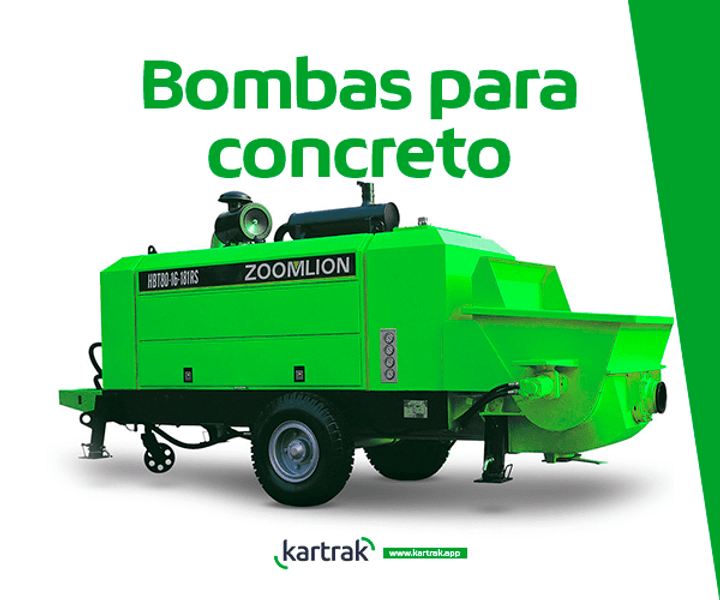
Depending on the model, the pump can be mounted on a truck chassis or work as tow-behind equipment, attached to another vehicle.
Configurations and classifications
Each type of pump serves a different job-site need. Get to know the main groups:
Boom pump
Mounted on the truck chassis, it features an articulated distribution mast with three or more segments depending on its length. In Brazil, models typically range from 28 to 43 meters, with the largest model in operation reaching 63 meters.
Trailer pump
It has no distribution mast, but offers performance equivalent to that of the boom pump. It must be towed and requires the assembly of 5-inch piping. It is commonly used in buildings, warehouses and continuous flight auger piles.
Auto pump
This is a stationary pump mounted on the truck chassis, which eliminates the need for a towing vehicle.
Distribution mast and spider
Equipment installed on the slabs of high-rise buildings with the help of cranes. It speeds up concrete distribution and reduces placement time on vertical projects.
Variations in piping diameter
Stationary pumps and auto pumps differ according to the application. On residential projects, lower-power units with 3-inch hoses instead of 5-inch piping keep the ideal concrete consistency for slabs and beams.
The largest pump in Latin America
The BSF63Z auto pump represents the highest productivity in the sector, pumping more than 200 cubic meters per hour, the equivalent of about 25 mixer trucks. Manufactured by Putzmeister, the equipment serves buildings of up to 20 stories, bridges and silos.
The unit is adapted by the Brazilian factory in Atibaia and mounted on an Iveco 10X4 chassis with 15-meter axles. The five-stage boom, with RZ opening, allows operation in spaces with a ceiling height of approximately 12 meters.